Welcome to a new installment of Jugger Handbook! Today we’re not going to talk about weapon technique or physical preparation. We’re going to talk about something that happens before the strike, during the point, and after the whistle: the mental game.
And we’ll start with an uncomfortable question: do you train your body but leave your mind to fend for itself on competition day?
If the answer is yes, this article is for you.
What Matters Most Requires No Talent At All
Before diving into tactical psychology, we need to lay a foundation that often gets overlooked, because many players go looking for the secret in technique, physical conditioning, or tactics, and end up ignoring what actually makes the difference in the long run. And the paradox is that nothing we’re about to cover requires talent. It only requires commitment.
Showing up to training is the first pillar: the player who shows up improves; the one who doesn’t, doesn’t move forward — it’s that simple. But being physically present isn’t enough if the right attitude doesn’t come with it, because in competition you control very few variables, and your mental disposition is one of the few that depend entirely on you. On top of that comes sustained hard work, without which no shortcut is worth anything, and the ability to listen and learn, since the player who thinks they already know it all stops growing the very moment they think it. Supporting your teammates also factors into this equation: a team that holds each other up competes in a qualitatively different way than one that ignores each other under pressure. And finally, consistency, which is perhaps the hardest of all, because one brilliant training session builds nothing if you skip the next one.
None of this is talent. All of this is choice. And if this piece isn’t sorted out, the rest of this article won’t do you much good.
These six pillars are the foundation everything else is built on. But there’s one area where attitude alone isn’t enough: the face-to-face duel, where the difference isn’t decided by who’s faster, but by who better understands the space separating the two players.
The Distances in a Duel: Why the Problem Is Almost Never Your Speed
One of the most common mistakes on the field has a very specific shape: you attack, you fall short, or worse, you get hit before you can react. And the immediate, almost automatic conclusion is “I’m slow.” However, the real problem, in most cases, has nothing to do with speed. It has to do with the fact that you and your opponent aren’t experiencing the same distance.
There are three distances in a duel, although most players only consciously manage the first one.
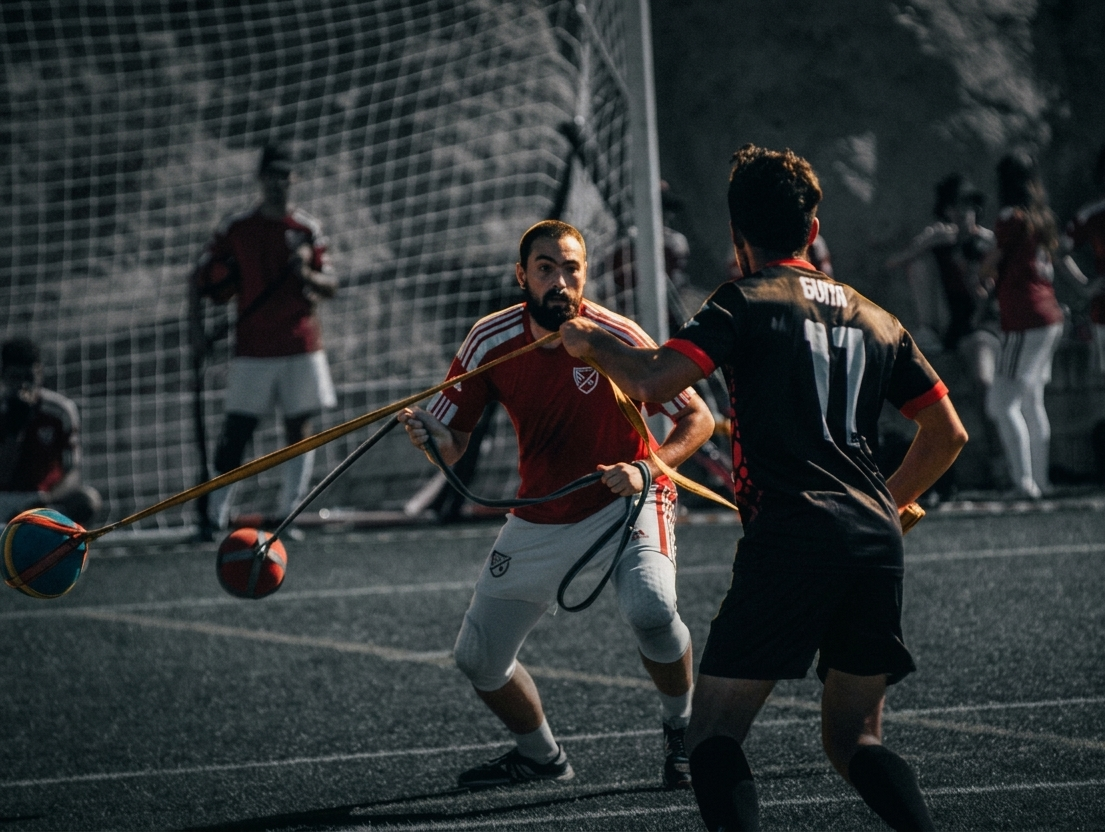
Real distance is the most obvious: can you reach with your stick from where you’re standing? Do you need to advance? Are you nowhere close? This is the physical distance, the one measured in meters. But there’s a second layer that completely changes the dynamic of the point: psychological distance. If you advance and your opponent backs off before you’ve even struck, you’re already getting to them mentally. You’ve invaded their mental space before throwing anything, and that’s already a form of control. And then there’s dangerous distance, perhaps the most interesting of the three: same feet, same position on the field, but you change the rhythm, introduce a pause, shift the position of your stick… and your opponent reacts differently. That’s not speed. That’s managing the perception of threat.
Within that dangerous distance, there’s still a nuance worth separating out on its own, because it changes the question you should be asking yourself mid-duel. Most players measure distance with a single binary question: “Can I reach or not?” But the question that really decides the point is different: does my opponent believe I can reach them?
If your opponent doesn’t feel threatened, they don’t react. If they feel too threatened, they decide too early. And when they decide too early, they’re handing you information: they break distance, tense up, stop dead, or counterattack before you’ve committed to anything. That’s where ambiguous distance comes in: the zone where your opponent doesn’t know for certain whether they’re safe or in danger. And often, holding yourself in that doubt is worth more than attacking fast, because that’s exactly where your opponent, without you having done anything yet, starts giving away information about what they’re going to do.
All of this boils down to a single idea: it’s not the player who advances the most who wins. It’s the player who understands timing, distance, and the exact moment to strike.
Losing Duels Without Extracting Information Is Costly
The first exchanges of a point aren’t just about the scoreboard. Above all, they’re information. It’s worth remembering that you can lose one or several duels during a point and still win it, but if every time you’re taken out of action you only think about recovering position quickly, you risk stopping paying attention to the game your opponent is trying to impose on you — and that has a real cost as the match unfolds.
After the first exchanges, there are three specific things worth focusing your attention on. The first is the distance they hit you from: were you too close? Did they catch you from far away when you thought you were out of their range? The second is identifying which reaction they’ve repeated, because nobody improvises all the time, and if they’ve done something twice in a row, there’s a good chance they’ll do it again. The third, and perhaps the most revealing, is asking yourself where they wanted you to enter: if a gap has appeared twice in a row in the same spot, be suspicious. You don’t need to analyze twenty details at once. What you need is to stop entering blindly.
The first duels are a gift of information if you know how to receive them. If you only interpret them as hits against you, you’re throwing that advantage in the trash. And that same information is precisely what lets you recognize when your opponent is about to use it against you.
Psychological Manipulations on the Field: How You’re Controlled Without Noticing
Here’s the core of this article. Because there are players who don’t beat you by being faster, stronger, or more technical. They beat you because they get you to do what they want, when they want, while you feel like you’ve made your own decisions. This has a name, it has concrete ways of showing up on the field, and it has a solution.
1. The Bait
You see a gap. Too obvious, too clean, too easy. You go in, and that’s where you fall.
The bait is a trap disguised as an opportunity. Your opponent shows you an open door with the sole purpose of slamming it shut once you’re inside. They didn’t hit you because they’re faster than you — they hit you because they convinced you it was your moment, when in reality it was theirs. The clearest sign that you’re being baited is that the gap appears right when you’re feeling the most urgency to attack, when you’ve gone through several exchanges without finding an opening, or when the point is dragging on and the pressure is rising.
The right response isn’t to stop dead or become overly cautious. It’s to feint, to test, to make your opponent react before you hand over your entry. If the gap is real, it’ll still be there after the feint. If it was a trap, you’ll see it close before you’ve committed to the movement.
But the bait isn’t just something you need to know how to spot — it’s also a tool you can build yourself, and this is where a resource that many players instinctively dismiss comes in: retreating. Giving up ground doesn’t always mean losing the initiative. A player can retreat specifically to provoke the opponent’s entry, let them commit, make them overextend, and respond right at the moment they’re exposed. That’s not fleeing. That’s building the action from behind. Used this way, the retreat is a bait of your own: instead of waiting for your opponent to do it to you, you’re the one opening the door with every intention of slamming it shut at the exact right moment.
2. Intimidation
Intimidation on the field doesn’t always take the shape of an aggressive stare or an out-of-place comment, though sometimes it does show up that way too. Far more often, it appears in subtler forms that are harder to spot in the moment: excessively hard stick contact in exchanges where it wasn’t necessary, gestures of superiority after winning a point, brute-force actions specifically designed to make the opponent enter the next exchange tense.
The goal is always the same: to get you to enter afraid, with your pride wounded, or with your mind occupied by something other than the point. Any of those three conditions pulls you off your plan. And the response to all of them isn’t to fight harder or return the intensity of the contact. It’s to execute a simple order: stick up, clear distance, and if the contact was hard — step out, reset, and come back. When your opponent tries to intimidate you and you respond according to plan, you’ve already won that psychological battle, regardless of how the point ends.
3. The Change of Rhythm
This is probably the subtlest of the four manipulations. It’s not about going faster — it’s about making you enter when they want. Your opponent sets a rhythm in the interaction, a pulse of approaches and retreats, and at the most strategic moment, they break it. And your body enters on its own, without you having made any conscious decision. This is called broken timing, and when you don’t detect it, you feel like you chose the moment to enter, when in reality that moment was handed to you.
Next time you notice the rhythm of the exchange cutting off right before the good distance, don’t take the bait. Hold half a beat longer than your impulse tells you to. Make them repeat the sequence. And ask yourself honestly: am I entering… or am I being sent in?
4. The Opponent Who’s Always Waiting for You
If your opponent consistently arrives before you, it’s rarely a pure speed problem. It’s almost always a problem of involuntary tells. Your usual starting distance, the rhythm you build up before attacking, and the small pause you make right before committing have already told them when you’re about to go. They’ve read you, they’ve been waiting for you for several points now, and most likely, they’re not even fully aware they’re doing it — they’ve simply calibrated your pattern.
The solution isn’t to change your entire game all at once, because that would confuse you more than your opponent. It’s to change a single variable and observe what happens. Try starting from half a step farther than usual, or keep the same distance but remove the pause before entering, or throw a feint with no real follow-through. If your opponent reacts differently, you’ve got confirmation they were reading you. And now you’ve got control back, because you know which tell you need to change.
Signs That You’re Already Being Read
Detecting that your opponent has your game figured out is easier than it seems if you know what to look for. The clearest signs are these: they arrive before you go, even though you haven’t done anything obvious to signal it; their responses are too consistent to be coincidence, because doing the same thing twice in a row isn’t luck; they change position right when you’re about to attack, which shows they’ve read your setup; the bait appears at the moments when you’re most nervous, because they know exactly when you’re most vulnerable; and they intimidate you specifically at the moments when you’re ahead, because it’s not an impulse — it’s strategy.
When you start noticing these patterns in the heat of the point, something changes: you stop just reacting and start reading too.
Everything covered so far — reading distances, extracting information from duels, detecting and deploying manipulations — ultimately depends on a single ability: where and how you direct your attention in each moment of the point. And that ability, like any other physical capacity, can be trained.
Preparing Body and Mind to Compete: What No One Tells You About Nerves
We’ve reached the final section, and probably the most important one when it comes to actual competition day.
How many times have you heard “relax” before heading onto the field? It’s advice given with the best of intentions, and yet it sometimes leaves the player completely stranded, because it starts from a premise that isn’t always true: that pre-competition anxiety is a problem that needs to be eliminated.
If the competition genuinely matters to you, that activation doesn’t go away. You feel it in your body, you feel it in your head, and the harder you try to shut it off, the more present it becomes. The key isn’t to eliminate it. It’s to normalize it and learn to interpret it usefully.
The first thing that changes when you work on this is how you interpret the physical signals: sweaty hands, a racing heart, muscle tension don’t necessarily mean you’re about to fail. In many cases, they’re the exact same signals that accompany peak performance, and the difference between being dragged down by them or lifted up by them lies in how you read them. Instead of trying to switch that energy off, the goal is to channel it: controlled aggression isn’t losing your head — it’s stepping out to impose yourself from the very first exchange without hesitating for even half a second.
Attentional Focus: The Mechanism Behind Everything Above
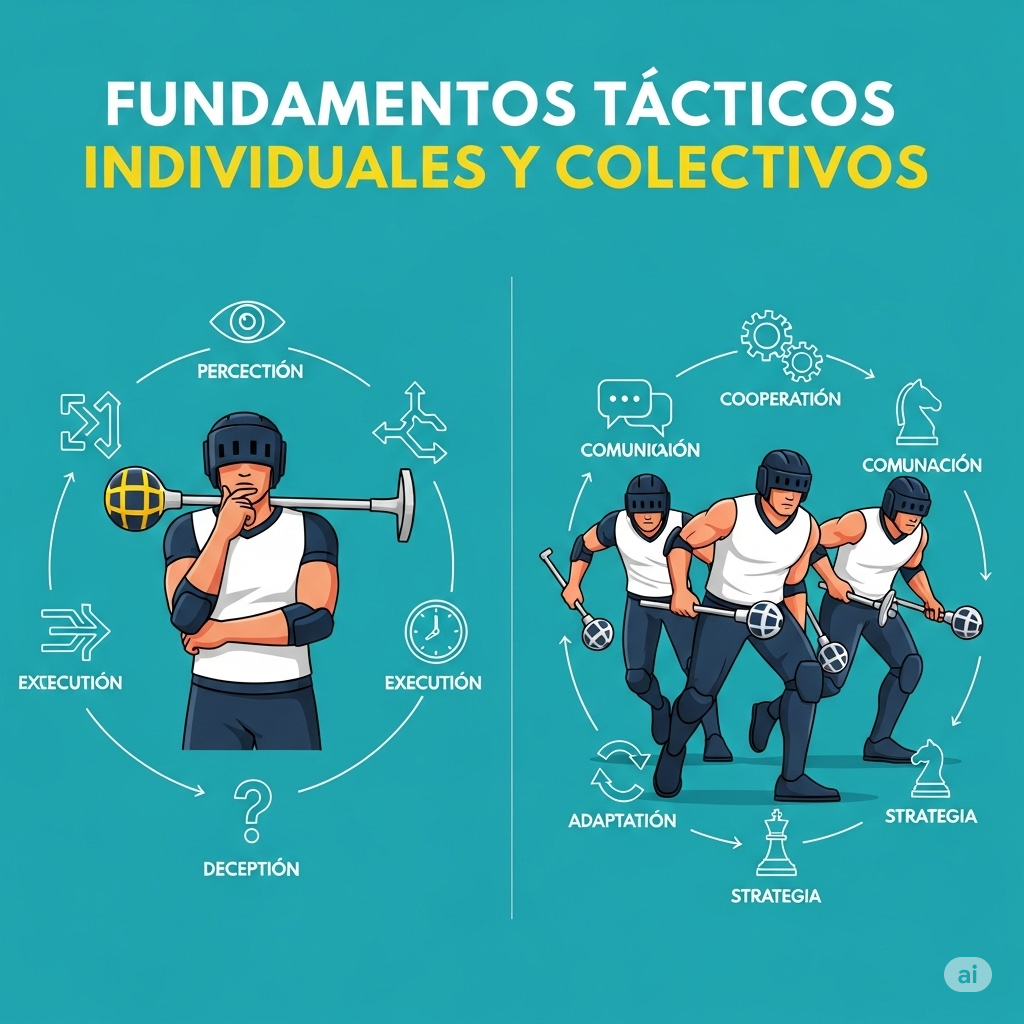
Here it’s worth putting a technical name to something that, if you’ve made it this far, you’ve already been practicing intuitively throughout this entire article: attentional focus. Sport psychology has spent decades working with this concept through a model built on two axes: the breadth of focus, which can be broad or narrow, and its direction, which can be external or internal. Combining these two axes produces four distinct ways of paying attention, and a high-level player needs to move between all four depending on the moment in the point.
When you’re reading the whole point — where your teammates are, where the Qwiker is moving, what the rival team is trying to set up — you’re using a broad-external focus. When you’re locked into a 1v1 duel and all your attention narrows down to your opponent’s stick, their distance, and their rhythm, you’re in narrow-external focus: exactly the type of attention the duels we discussed earlier demand, where you can’t afford even a moment of distraction. When you turn the feeling of “I’m nervous” into an operational instruction like “energy ready, focus on timing and distance,” you’re working a narrow-internal focus, directed at your own sensations but with a very specific purpose. And when you analyze what’s happening between points and adjust your plan, you’re in broad-internal focus.
Detecting baits, reading changes of rhythm, extracting information from the first duels — all of that, at its core, comes down to keeping the right focus at the right moment and not letting your opponent steal it from you. And that’s why simply normalizing activation isn’t enough on its own. It also helps a great deal to make that activation measurable and operational. Instead of staying stuck in the vague feeling of “I’m nervous,” replace it with a concrete instruction that directs your attention toward what you actually control. That brings your mind back to the specific task and cuts off the rumination loop.
And finally, real normalization only happens once that pressure stops being something new. If you only experience it at major tournaments, your nervous system interprets it as a threat. If you’ve built it into your training regularly, through situations of internal pressure, it stops being an alarm and starts becoming a familiar routine.
The conclusion is this: don’t just train your body to compete. Also train where you place your attention and how you manage pressure. The player who has experienced that tension many times in training recognizes it in competition as an old acquaintance, and that’s an advantage that can’t be bought or improvised.
Conclusion
Talent matters, technique matters, and physical conditioning matters. But the mental game is fought in every point, every exchange, every decision you make — or that you let your opponent make for you.
Show up, work with consistency, maintain the right attitude. Read the real distance, the psychological one, and the ambiguous one. Extract information from every duel instead of seeing them only as hits against you. Recognize manipulations before falling for them, and learn to build them yourself when it suits you. Normalize your nerves instead of fighting them, and deliberately train where you direct your attention at each phase of the point. All of this is available to any player, regardless of their current technical or physical level, and none of it requires special talent. It only requires training it with the same intention you bring to everything else.
Which of these points resonated with you the most? Let us know in the comments, and if you’d like us to dive deeper into any of them in a future post — visualization, goal-setting, pre-competition routines — tell us which one.
Discover more from Jugger Handbook
Subscribe to get the latest posts sent to your email.