Tactics in Team Sports
Team sports all share the same goal: prevent the opponent from scoring while scoring ourselves — all within a constantly changing environment. Technique is knowing how to do something, while tactics is knowing when to do it.
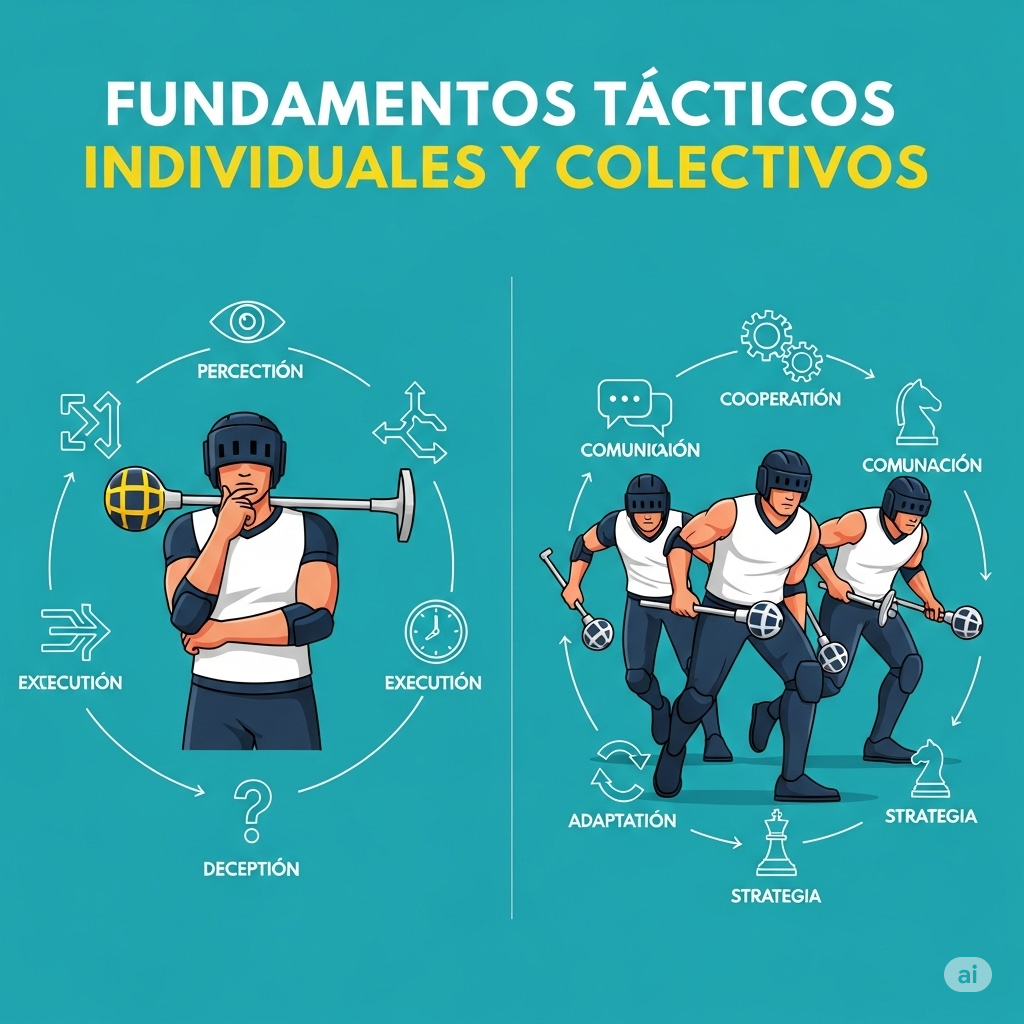
Both offensive and defensive tactical actions can be: individual, group-based, or team-based. Adapted from Kirkov (1982).
Concept of Individual Tactics:
The intelligent use of technique to solve in-game situations — though it’s really not just about correctly applying technique, but about using one’s own resources (physical, technical, cognitive) to effectively resolve each game situation against an opponent, without support from teammates.
Individual tactics are influenced by: opponents, one’s own abilities, and the surrounding environment.
Concepts of Collective Tactics:
These are actions in which several players must analyze the positioning of opponents and teammates in order to decide and execute the most appropriate collective action to achieve a shared goal. This requires: cooperation, mutual understanding, and solid communicative training.
Collective tactics are influenced by:
Teammates and opponents.
Communication and counter-communication from the rival team.
The capabilities of both one’s own team and the opposing team.
Constant adaptation to the environment.
Individual Tactics
Phases and Analysis of the Tactical Action:
Perception
Decision-making
Execution
Tactical Differences Based on Athlete Level:
Defining Characteristics of Tactics:
Shaped and conditioned by the opponent’s actions.
Involves adapting to unpredictable, unknown situations.
Evaluation depends on the effectiveness of the action taken.
As skill level increases, faster execution is required (i.e., greater spatial-temporal precision).
Benefits from deception, feints, and surprise.
Common Decision-Making Errors:
Incomplete analysis of the situation (insufficient perceptual information about the environment).
Indecision from overanalyzing.
Rushed decisions due to pressure, time constraints, or an unfavorable score.
Lack of clarity or defined objectives (“What are we trying to do?”).
Emotional impulsiveness.
Repeatedly showing the same decision-making preferences — in other words, being predictable.
Offensive-Defensive Tactical Fundamentals:
Basic Fundamentals:
Individual Tactical Concepts/Fundamentals:
Timing: A tactical action that involves adjusting the speed or moment of executing a physical/technical/tactical action, in order to buy time for other players to help carry it out.
Watching/Monitoring: A tactical action in which players on a team keep track of the position of opposing players who don’t appear to be directly involved in the play at that moment.
Anticipation: A tactical action in which a player changes their position relative to another player, positioning themselves to interfere with the opponent’s play.
Switching/Covering: A tactical action in which a player takes over or swaps positions on the field with a teammate who has moved to help cover a different role.
Methodological Aspects for Teaching/Learning in Different Contexts:
Common Tactical Errors in Early Sport Development:
Objectives of Tactical Learning:
This involves improving the ability to apply learned physical, technical, tactical, and psychological skills, as well as developing decision-making within a collaboration/opposition context.
The methodological progression aims to gradually improve the player’s relationship with:
Themselves and their own body control.
The moving object/implement + space: knowing how to move through space while controlling an implement.
The moving object + space + rules and their possibilities.
The moving object + space + communication with teammates.
All of the above + opponents.
All of the above + overall collective strategy.
The level of difficulty should be optimal — neither impossible nor too easy. Learning can be broken down into different phases:
Acquiring the sport’s technical-tactical and rule-based fundamentals.
Developing perceptual ability.
Developing game intelligence.
Exercise difficulty should increase progressively:
Exercises without an opponent.
Exercises with a passive opponent.
Exercises with an active opponent.
Facilitated situations (numerical advantage).
Competitive situations.
Elements used in learning to adjust cognitive complexity:
The elements of these teaching variations for tactics include:
Goals/scoring zones.
Instructions/cues.
Number of players.
Playing space.
Equipment.
Collective Tactics
Collective Tactics vs. Playing System:
Tactics are actions in which several individuals must analyze the situation of opponents, rivals, and teammates in order to decide and execute the most appropriate collective action to achieve the objective. Riera (1990).
A playing system is the overall structural and functional organization of the team, established in advance. Adapted from Teodorescu (1984).
Characteristics of a Playing System:
Player characteristics: The system is structured based on the physical, technical, tactical, and psychological characteristics of both one’s own players and the opponents, both offensively and defensively.
Specific positions/roles: Defined areas of action for each player within the system, supporting specialized, role-specific work based on their characteristics.
Initial setup: The spatial distribution of players on the field at the start of each play.
Relationships between players: The motor/movement-based communication established between players on the same team, based on the initial setup, forming small in-game sub-structures.
Options When Designing a Playing System:
Adapting players to a pre-conceived theoretical system.
Building a system based on the players’ characteristics.
Adapting a theoretical system to fit the team’s characteristics.
Phases and General/Specific Principles of Collective Play in Playing Systems:
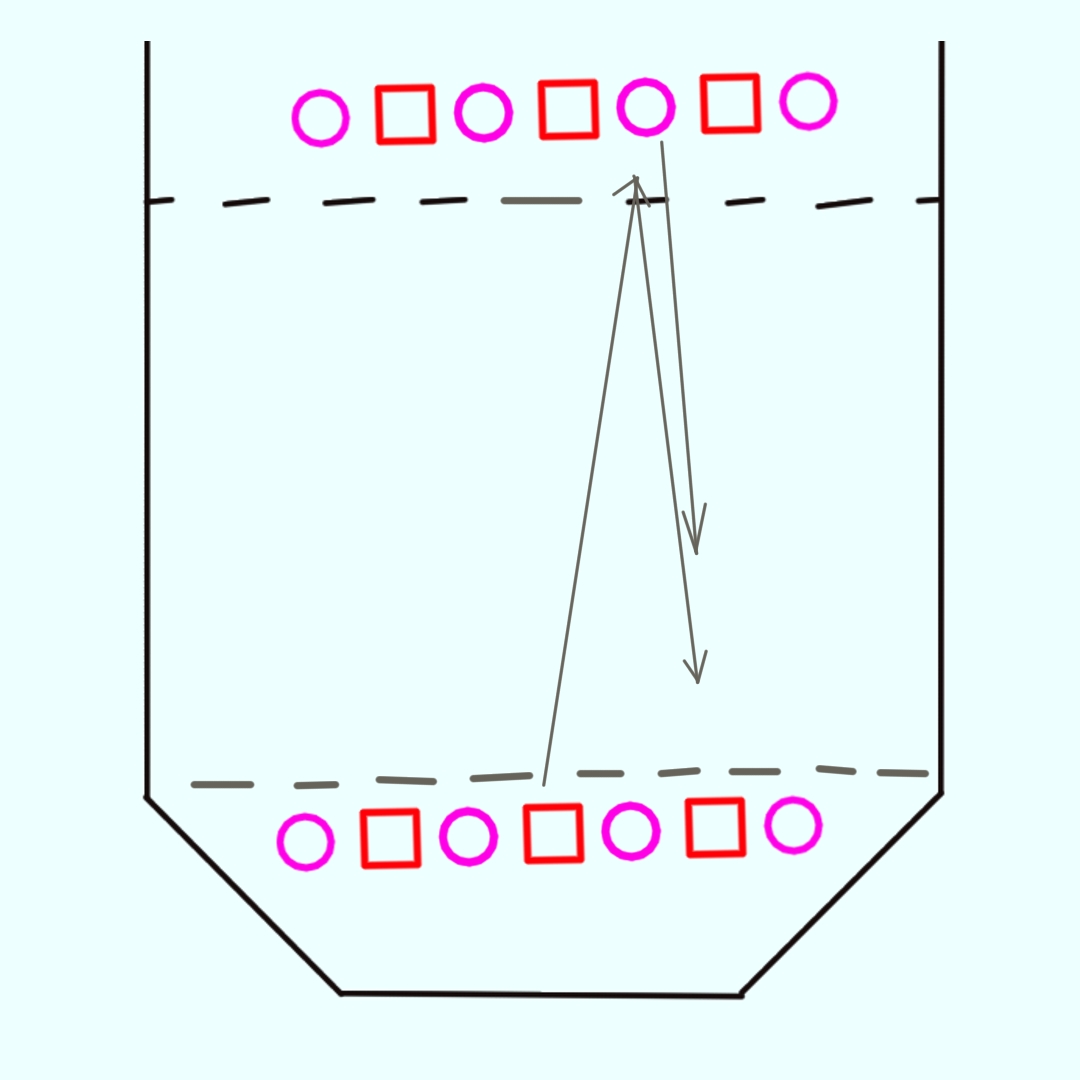
Hernández Moreno created a general diagram for team sports based on possession or non-possession of the ball.
I’ve adapted this diagram for Jugger, where, in many cases, play doesn’t actually depend on possession of the Jugg.
Methodological Aspects for Teaching/Learning in Different Contexts:
Considerations for Teaching Collective Tactics:
Help players understand the usefulness of collective tactics for achieving objectives.
Progress from semi-passive defenses (in intensity or space) to active ones.
Set up situations in different areas of the field and from different positions.
Modify initial setups: field positioning, width, depth, etc.
Propose situations involving prioritization, decision-making, and anticipation.
Alternate basic drills with situations that resemble real gameplay.
Link the final goal (scoring) with the goal of achieving specific proposed content, while keeping the logic and principles of the game intact.
Progressive Difficulty of Collective Tactical Tasks:
Factors to take into account:
Give players the chance to express their own abilities and solutions in service of the team.
Allow room for improvisation (players’ own initiative in problem-solving).
Don’t confuse freedom of action with individualism.
Objectives of Teaching Collective Tactics:
The main goal is to teach the team how to face and overcome another team. To achieve this, the method involves:
Adapted but authentic, realistic situations.
Start practice by learning global tactics first.
Progress from free play to guided play with specific instructions.
Gradually introduce:
Technique + Individual Tactics
Modify trajectories and spatial-temporal conditions.
Start with games and exercises of low technical-tactical complexity, adjusting:
Space
Time
Number of players
Never lose sight of the essential collaboration-opposition nature of the game.
Use modified games with specific transfer value.
Balance the development of both individual and collective tactics.
Global Methodology for Teaching Tactics:
Progression for Learning to Attack:
Learn to keep/protect possession of the ball or a space.
Learn to advance through space toward the objective.
Progression in Using Numerical Relationships in Tactical Learning:
The process evolves by:
Moving from more available space to less.
Moving from more available time to less.
Including finishing/scoring actions.
With or without specific attacking positions.
Progression for Learning to Defend:
Learn to defend the goal.
Learn to try to regain possession of the ball.
Learn to force the attacker into more complex finishing situations.
The process evolves by:
Moving from more available space to less.
Moving from individual to zonal defense.
Moving from no defensive support to having it.
Moving from seeking the ball to protecting space.
With or without specific defensive positions.
Discover more from Jugger Handbook
Subscribe to get the latest posts sent to your email.