Introduction
Welcome to a new installment of Jugger Handbook! Today we’re going to dig into some hardcore physiology. As sports science graduates, we often see physical training plans in Jugger that lack scientific rigor. There’s an overreliance on steady-state running or extreme gym routines, without understanding the genetic-level impact this has.
Today we’re going to talk about Myosin Heavy Chains (MHC), why your fast-twitch fibers are turning into slow-twitch ones, and a harsh reality: this transformation is a one-way street. Don’t worry if you’re not into science — today I’ll translate all this medical terminology so you understand exactly how your body works, and why you might be sabotaging your own speed on the field.
The Molecular Basis: Myosin Heavy Chains (MHC)
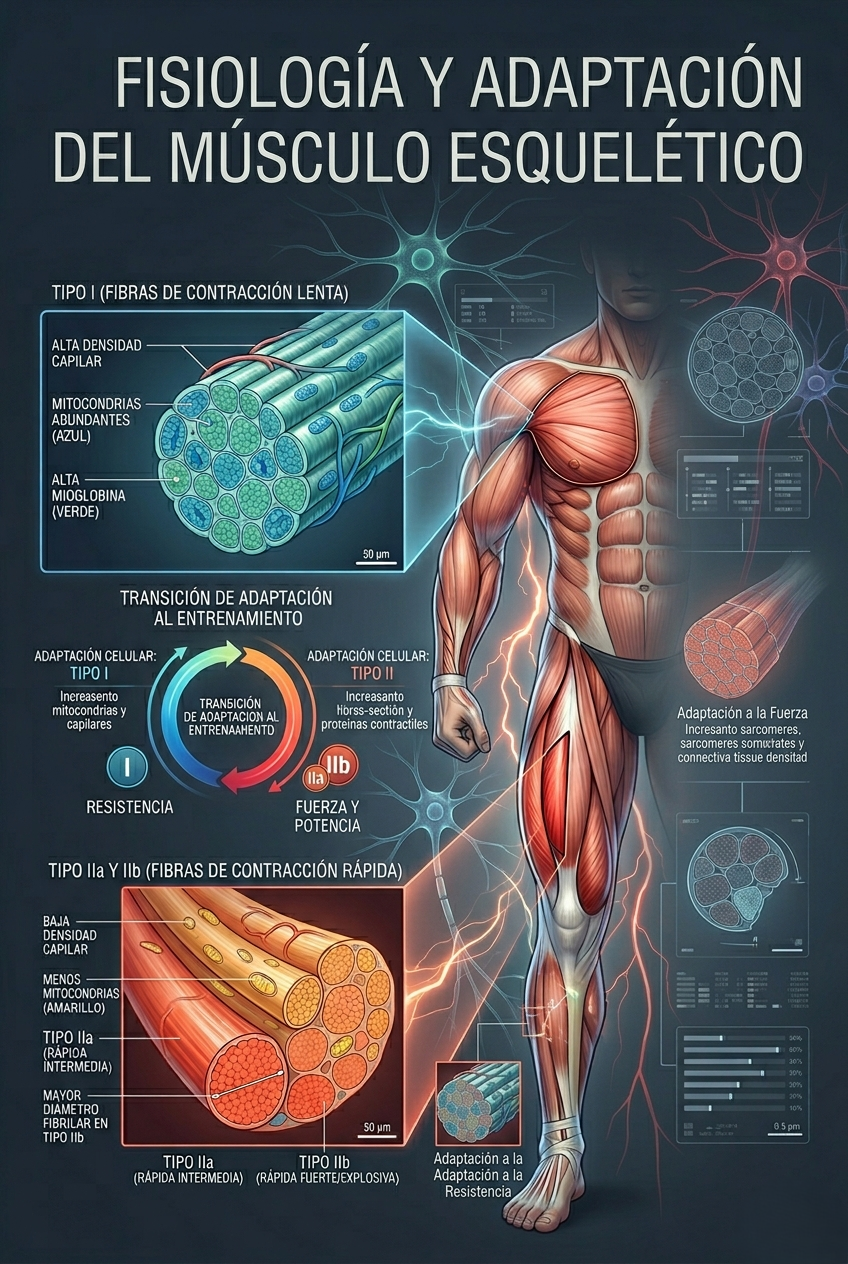
For a muscle to move, it uses contractile proteins. The main one is myosin. Depending on the type of myosin your muscle has, you’ll be faster or more endurance-oriented. We call this Myosin Heavy Chains (MHC), and in humans there are three main types (phenotypes):
MHC I (Slow-Twitch / Oxidative Fibers): Your diesel engine. They have lots of mitochondria (the cell’s energy factories) and use oxygen to function. They take a long time to fatigue, but they’re very slow.
MHC IIa (Intermediate Fibers): The bridge. They strike a decent balance between strength, speed, and endurance.
MHC IIx (Ultra-Fast / Glycolytic Fibers): Your Formula 1 engine. They don’t use oxygen, but rather the immediate energy stored in the muscle (ATP and phosphocreatine). They deliver maximum explosiveness, but their “fuel” runs out in just 10-15 seconds.
The Cruel Law of Physiology: A One-Way Street
Here lies the biggest problem for Jugger players. Your muscles’ adaptation follows a predictable order: MHC IIx ➔ MHC IIa ➔ MHC I. In other words, from fast to slow.
Why does this happen and not the other way around? Pure evolutionary survival. The human body is “stingy” with energy. Maintaining ultra-fast fibers (IIx) burns a lot of energy. Under almost any consistent training, your body will look to save energy by converting your fast fibers into slow ones.
Can slow fibers be turned back into fast ones? The scientific literature shows they can’t. It’s nearly impossible for a slow fiber to become a purely explosive one. The most we can do is train the fast fibers we already have so they grow larger and dominate the muscle. If you lose your baseline speed, getting it back is a nightmare.
The Speed Destroyers: Molecular Signaling Pathways
How do you unknowingly force your body to slow down? Through two classic mistakes:
Excessive Cardio (The AMPK Pathway): When you go out for a 45-minute run, your body burns a lot of energy. This activates an enzyme called AMPK (think of it as your phone’s “low battery” sensor). This sensor triggers an alarm called PGC-1α, which tells your DNA to create more mitochondria to withstand the effort. The genetic result is relentless: your body stops producing fast-twitch proteins, and your IIx fibers turn slow.
Bodybuilding and Drop Sets (Metabolic Stress): If you do sets to failure at the gym (until you literally can’t do another rep) or drop sets (lowering the weight and continuing to lift), you create hypoxia (lack of oxygen in the muscle) and build up waste products like lactate (that “burning” sensation in the muscle). To survive that acidic environment, your fast fibers mutate into intermediate ones. You gain muscle size (you get bigger), but you lose real contraction speed.
Biomechanical Consequences in Jugger
Jugger is an intermittent power sport (very short, violent bursts of effort). If your fibers turn slow, you’ll suffer two major problems:
A drastic drop in RFD (Rate of Force Development): RFD is how quickly you can apply your strength. Picture a truck and a Ferrari; both have 500 horsepower, but the Ferrari puts that power down to the asphalt in 0.1 seconds. In Jugger, a Pompfen block or a Qwiker’s burst happen in milliseconds. If your RFD drops, even if you’re very strong (the truck), your opponent will hit you before you can use that strength.
Increased Electromechanical Delay (EMD): This is the time between your brain sending the command and your muscle actually moving. Think of it as the “lag” or “ping” in a video game. If your fibers are slow, your “ping” goes up. Your reflexes get worse.
Practical Application: How Do We Save Our Fast Fibers?
Since we can’t create new fast fibers, the goal is to protect the ones we have.
Velocity-Based Training (VBT): In the gym, it’s not just how much weight you lift that matters, but how fast you move it. Lift the weight with maximum intentional speed. If the bar moves slowly, you’re training slow.
Avoid muscle failure (Control your RIR): RIR stands for “Reps in Reserve.” If you’re lifting a weight you could do 10 reps with, do only 5 and rest. By not reaching extreme fatigue, you avoid triggering the “low battery” sensor and protect your fast fibers.
The “Overshoot” Phenomenon (The Magic Rebound): The only scientifically proven way to temporarily increase your IIx fibers is through tapering. If you train strength for months and then, 2 weeks before an important tournament, drastically reduce your training load, your body experiences a “rebound” (overshoot). Your intermediate fibers temporarily become ultra-fast. That’s the secret to arriving at the tournament flying!
Conclusion
The science is clear: speed is fragile, and endurance is dominant. In Jugger, your training needs to be smart. Stay away from empty miles of running and dragging yourself out of the gym exhausted. Train like a power athlete, and protect your fast fibers like the treasure they are.
Questions on how to apply these concepts to your own routine? Leave them in the comments and I’ll—
Discover more from Jugger Handbook
Subscribe to get the latest posts sent to your email.