Introduction
When we think about the physical capacities that define a good jugger player, we tend to go straight to explosive striking power, first-step speed, or the endurance needed to survive a full day of tournament play. There’s one capacity that’s rarely called by its technical name but that, in practice, sits behind almost every decisive moment of a match: Repeated Sprint Ability (RSA).
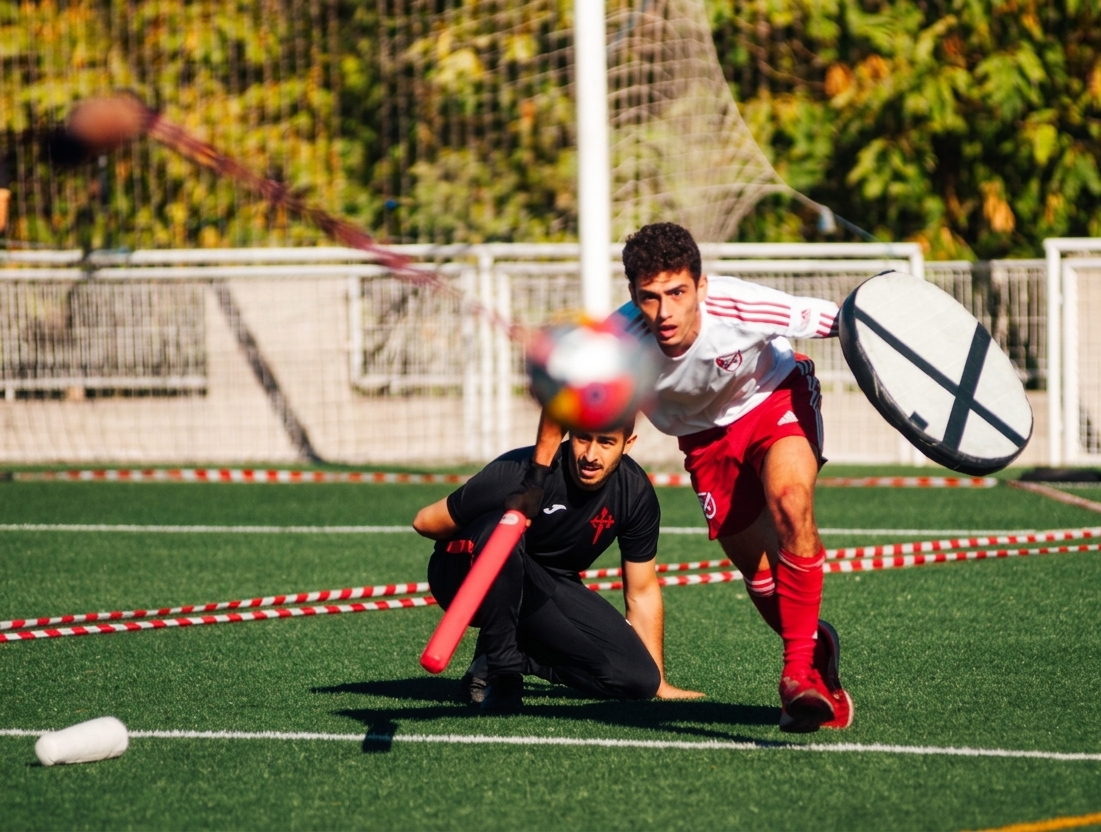
We’re not talking about running fast once. We’re talking about accelerating to maximum, braking, accelerating again, changing direction to cut off the Qwiker’s line, backing up in guard with the stick, and then, seven or eight seconds later, having to do it all again at almost the same intensity. That ability to reproduce maximal efforts with incomplete recovery is exactly what sport science has spent more than two decades studying in team sports like rugby, soccer, and field hockey — and, in my view, it’s one of the pillars of Jugger-specific physical conditioning that gets trained deliberately the least.
What RSA Actually Is
RSA is defined as an athlete’s ability to recover and sustain maximal effort across successive sprints, an attribute considered important in team sports (Dawson, 2012). In more operational terms, it’s described as series of very short sprints — just 3-4 seconds, over 20 to 30 meters — separated by brief recovery periods of between 10 and 30 seconds (Dawson, 2012).
Notice the almost literal parallel with what happens on the field: a player doesn’t run a flat 100 meters. They run 3-5 meters to close off a line, brake sharply, turn their shield, back up in guard, and a few seconds later explode again to cover a teammate who’s lost their duel. That pattern of effort-recovery-effort is, almost by definition, an RSA scenario.
The Mechanisms of Fatigue: Why “the Second Sprint” Gives You Away
What’s interesting about RSA isn’t so much the speed of the first effort, but how much that speed degrades in the ones that follow. Exercise physiology research has identified that much of that performance drop is driven by intramuscular factors linked to high-energy phosphate metabolism — ATP and phosphocreatine (PCr) — rather than lactic acid buildup, as was traditionally believed (Girard et al., 2011). Put simply: every maximal sprint partially drains the muscle’s phosphocreatine stores, and if the recovery time between efforts isn’t enough to resynthesize it, the next sprint comes out worse — with no room to “rely on technique” to make up for it.
On top of this, there’s a neural component. Research has documented reduced activation from the central nervous system toward the muscles involved, along with drops in electromyographic signal amplitude and changes in motor unit recruitment strategies as sprints accumulate (Girard et al., 2015). In other words, it’s not just the muscle running out of “fuel” — the nervous system itself becomes less able to command repeated maximal contractions.
For Jugger training, this has a very concrete implication: having a good VO2 max or solid aerobic endurance for a full tournament isn’t enough on its own. The limiting factor in those decisive duels late in a point is usually local metabolic and neuromuscular fatigue, not general cardiovascular capacity.
Why Jugger Is, Structurally, an RSA Sport
If we compare the definition of RSA with the structure of the game, the overlaps are hard to ignore:
Duration of efforts: individual stick duels rarely last more than a few seconds of real exchange before someone “dies” or the confrontation is resolved; the rest is repositioning.
Incomplete recovery: when a player “dies,” there’s no full recharge before returning to action. The stone count they must complete is a real rest period of only around 7.5 to 12 seconds, but as soon as they’re back in play, the demand returns to maximum immediately. And while they remain active within that same point, the pauses between their own explosive actions (a positional correction, a line change, supporting the Qwiker) are far shorter still than that stone count after death — with almost no real rest between one action and the next.
Intermittent, unpredictable nature: just as in rugby, soccer, or field hockey — field sports where RSA has been widely studied for its intermittent nature and its dependence on time-motion analysis in competition — in Jugger the sequence of efforts doesn’t follow a fixed pattern, but instead depends on the opponent’s tactical decisions (Spencer et al., 2005).
There’s a rugby union finding that connects especially well with the essence of Jugger. In a study of semiprofessional players, forwards with better RSA — meaning lower cumulative time in a repeated-sprint test — performed significantly more accelerations and more contact/combat actions per minute of match play (Glaise et al., 2022). Translated to Jugger: a player with better repeated-effort capacity doesn’t just get to position faster — they can afford to initiate more duels and sustain more striking exchanges throughout the point without their explosiveness suffering.
How RSA Is Trained: What the Evidence Says
For years, two opposing training theories coexisted: those who argued that the best way to improve RSA is simply to train repeated sprints (pure specificity), and those who proposed directly targeting the limiting factors — aerobic capacity, power, fatigue tolerance — through other methods. The key review in this field concludes that it’s best to combine both approaches: including quality single-sprint work (“traditional” speed training and strength/power work) alongside high-intensity interval training to specifically improve recovery capacity between sprints (Bishop et al., 2011).
In practice, recent research in team sports mainly compares three approaches:
Repeated sprint training (RST). Series of short maximal sprints with brief pauses, directly replicating RSA demands. In a study with university rugby players, a six-week RST program produced greater improvements than traditional HIIT in both aerobic and anaerobic capacity, with more stable adaptations throughout the intervention (Wang et al., 2025).
HIIT (high-intensity interval training). Relatively long intervals at 80-100% of maximal oxygen uptake. This is a very time-efficient method, widely used in rugby and other team sports to improve maximal oxygen uptake, agility, and repeated-sprint capacity itself (Wang et al., 2025).
Small-sided games / tactical situations (SSG). In soccer, a meta-analysis directly compared the effect of small-sided games versus running-based HIIT on RSA: no significant differences were found between the two methods, and neither showed a significant effect on RSA on its own — suggesting this physical component likely needs a complementary stimulus rather than integrated tactical-conditioning work alone (Clemente et al., 2021). For Jugger, this is an important nuance: a drill built around short, successive repetitions is an excellent format for training tactical decision-making under fatigue, but it shouldn’t be the only path for developing RSA as a physical capacity.
Practical Application to Jugger Training
With all this in mind, I propose three concrete lines of work to incorporate RSA into a Jugger team’s training plan:
Short-sprint blocks with incomplete recovery, specific to implement use. For example, series of 4-6 sprints of 15-20 meters with a change of direction, followed by an explosive technical action with stick or kette (a strike, a block), with 20-25 seconds of recovery between reps. This directly targets PCr resynthesis under conditions similar to real gameplay (Girard et al., 2011).
Chained mini-stones. Play short points (2-3 minutes) with brief rests between them, prioritizing maximal intensity of actions over duration. In light of the evidence from soccer (Clemente et al., 2021), this format is useful for decision-making under fatigue, but should be combined with the repeated-sprint work described above, not used as a full substitute for it.
Periodic RSA testing by role. Adapt a repeated-sprint protocol (for example, 6 x 20 m with 20 s of recovery) and record both average time and the fatigue index (the percentage drop between the best and worst sprint in the series). This makes it possible to objectively track whether a player is improving their repeated-effort capacity over the course of the season, beyond the subjective feeling of “being in shape,” and to differentiate needs between roles based on their on-field action profile (Glaise et al., 2022).
It’s important to stress that RSA doesn’t replace explosive strength work or general anaerobic endurance — it complements them. A player with poor maximal strength will have a mediocre first sprint no matter how much RSA they train, and a player without sufficient aerobic base will take longer to resynthesize phosphocreatine between efforts. RSA is precisely the meeting point between both capacities: the evidence recommends training quality single sprints and recovery capacity between sprints as two sides of the same coin, not as independent capacities (Bishop et al., 2011).
Conclusion
Jugger isn’t a sport about running fast just once, nor is it a purely aerobic endurance sport. Structurally, it’s almost a textbook scenario for RSA: short, explosive efforts, incomplete recovery, and tactical unpredictability that demands being ready to repeat maximal effort whenever the game calls for it — not whenever the body has fully recovered. Understanding this isn’t just an academic exercise: it directly changes how we design physical conditioning sessions, prioritizing short-sprint formats with incomplete recovery over generic continuous work, and complementing them — not replacing them — with small-sided tactical situations. If we want our players to arrive at the fifth duel of the point just as explosive as they were at the first, RSA needs to stop being an implicit capacity and become a deliberate training objective.
Bibliographic References
Bishop, D., Girard, O., & Mendez-Villanueva, A. (2011). Repeated-sprint ability — Part II: Recommendations for training. Sports Medicine, 41(9), 741–756. https://doi.org/10.2165/11590560-000000000-00000
Clemente, F. M., Ramirez-Campillo, R., Afonso, J., Sarmento, H., Rosemann, T., & Knechtle, B. (2021). A meta-analytical comparison of the effects of small-sided games vs. running-based high-intensity interval training on soccer players’ repeated-sprint ability. International Journal of Environmental Research and Public Health, 18(5), 2781. https://doi.org/10.3390/ijerph18052781
Dawson, B. (2012). Repeated-sprint ability: Where are we? International Journal of Sports Physiology and Performance, 7(3), 285–289. https://doi.org/10.1123/ijspp.7.3.285
Girard, O., Brocherie, F., & Millet, G. P. (2015). Can analysis of performance and neuromuscular recoveries from repeated sprints shed more light on its fatigue-causing mechanisms? Frontiers in Physiology, 6, Article 5. https://doi.org/10.3389/fphys.2015.00005
Girard, O., Mendez-Villanueva, A., & Bishop, D. (2011). Repeated-sprint ability — Part I: Factors contributing to fatigue. Sports Medicine, 41(8), 673–694. https://doi.org/10.2165/11590550-000000000-00000
Glaise, P., Morel, B., Rogowski, I., Cornu, B., & Martin, C. (2022). Influence of repeated-sprint ability on the in-game activity profiles of semiprofessional rugby union players according to position. Frontiers in Sports and Active Living, 4, Article 857373. https://doi.org/10.3389/fspor.2022.857373
Mendez-Villanueva, A., Hamer, P., & Bishop, D. (2008). Fatigue in repeated-sprint exercise is related to muscle power factors and reduced neuromuscular activity. European Journal of Applied Physiology, 103, 411–419. https://doi.org/10.1007/s00421-008-0723-5
Spencer, M., Bishop, D., Dawson, B., & Goodman, C. (2005). Physiological and metabolic responses of repeated-sprint activities: Specific to field-based team sports. Sports Medicine, 35(12), 1025–1044. https://doi.org/10.2165/00007256-200535120-00003
Wang, S., Tang, J., Liu, S., Li, H., Li, Q., Pan, L., Chen, Z., & Liu, C. (2025). Improving of 6 weeks of repeated sprint training on the aerobic and anaerobic power of college-age male rugby players. Frontiers in Physiology, 16, Article 1620197. https://doi.org/10.3389/fphys.2025.1620197
Discover more from Jugger Handbook
Subscribe to get the latest posts sent to your email.